The Russell Institute
Russell Institute Logo

The Harvey C. Russell Jr. Institute
for International Business & Strategic Coalitions

Building the systems that make capitalism work for everyone.

Inclusive Capitalism Through
Policy Intelligence

America faces a paradox: the wealthiest nation in history cannot seem to extend prosperity to millions of its citizens. The exclusion runs on class, and it always has — capital, credentials, networks, and know-how rationed by permission rather than talent. Black Americans are the documented case: the one exclusion the system put in writing, in codes, covenants, and maps, which is why the machinery can be read there most clearly. But the same machinery prices out rural counties, small-town founders, and working families of every race. The gates never asked what you could build. They asked who you were.

This is not inevitable. AI is the first transformative technology since the printing press with the potential to democratize sophisticated capabilities. The Russell Institute's insight: AI makes inclusive capitalism scalable. We deploy Augmented Intelligence (AI²) to give excluded communities access to strategies previously available only to those with elite credentials and insider access.

Our premise is simple: American economic strength and national security depend on expanding who participates in wealth creation. This isn't redistribution — it's repositioning. When more Americans gain access to critical technologies and know-how, the entire system gets stronger.

Our papers are written to be read, understood and implemented — by policymakers, academics, and citizens alike. We believe clarity is a discipline, not a compromise. If an idea can't be explained plainly, it isn't ready for policy.

Read the Institute’s motto and credo →

Policy Intelligence

Research at the intersection of domains others cannot integrate

Augmented Intelligence

AI² instruments that capitalize human judgment and create owners

Coalition Architecture

Orchestrating networks into coordinated action

Institutional Design

Building structures that generate ownership shares by default

The most significant innovation since the printing press.

I

The printing press did not merely spread books. It broke the institution that rationed access to the thing that mattered most — and remade the order that rationing had built. Artificial intelligence is an event of that scale, and it is dissolving what the press dissolved: permission.

II

The gates that controlled who participates in wealth creation never rationed talent. They rationed permission — capital, credentials, networks, know-how. AI is collapsing the cost of everything the gates guarded. The permission system is failing, and it will not be rebuilt on the old terms.

III

What machines make abundant loses its premium. What they cannot supply — judgment, creativity, stewardship — becomes the scarcest asset in the economy. Judgment is human, unevenly capitalized, and found everywhere the old sorting never looked. A system that leaves it untapped is underproducing.

IV

A system delivers what it measures. The work of this Institute is changing the scorecard — from access to ownership. Not redistribution: repositioning. More owners, in more places, holding more of what this technology makes possible.

The question before the country is whether America unleashes a new era of dynamism in the 21st century — or spends the century rebuilding gates. This Institute exists to make the first answer true. Everything below is the evidence.

The Russell Institute makes this case where policy is made. Stratus Data Systems carries it into the market. The Institute for Stewardship Studies grounds it as a field. One argument, three instruments.

The American Ownership Index

A system delivers what it measures — and for sixty years, America has measured access. The American Ownership Index is the scorecard the Argument calls for: the first national instrument to measure what communities own — homes and property, businesses, financial assets, community institutions, and the productive technology of the AI era — rather than what they can reach.

Its methodological signature is the Floor. Most indexes measure how high the average rises. This one measures how low the floor falls.

Published annually by the Russell Institute as The State of American Ownership, beginning with a pilot cohort of fifty metropolitan areas built on public data. Its companion instrument, the Stewardship Index, is in development at the Institute for Stewardship Studies — one measuring whether the deed transfers, the other whether what transfers endures. One arc, two instruments.

Founding underwriter inquiries: the Founders’ Circle. Prospectus available on request.

Augmented Intelligence™ (AI²)

The first complete professional discipline for human-AI collaboration.

Eleven USPTO patent applications. One architecture. The IntellOps™ Operating System for AI.

The Platform

Chorus Basic
Schools · Students · SMBs
  • Multi-model AI orchestration
  • Compare responses across models
  • Quick actions & workflow patterns
  • Community Plan free for Title I & rural schools
Chorus Premium
Mid-Market Organizations
  • Symphony™ optimization engine
  • Trust scoring & calibration
  • 28-variable DMAIC quality framework
  • Verantus™ governance layer
Maestro Enterprise
Regulated · Defense · Life Sciences
  • Predictive AI model routing
  • Full compliance & audit suite
  • Enterprise governance & access controls
  • Closed-loop trust calibration

Inclusive by design: Community Plan free for Title I and rural schools, auto-verified via NCES. Student Plan available with .edu verification.

Patent-Protected Architecture

Eleven filings. One deliberate architecture.
The estate is filed as interoperable building blocks rather than product-specific patents — a foundation engineered to support product configurations beyond the first.

COG™

Cognitive Orchestration Grammar — the first standardized notation for human-AI workflows.

Patent Pending

CPE™

Cognitive Process Excellence — Six Sigma and Lean principles applied to AI quality control.

2 Patents Pending

AI Orchestration

The integrated system for task routing, context preservation, parallel execution, and human gates.

Non-Provisional Filed

Symphony™

Parallel multi-model evaluation with adjudicated quality assessment.

Patent Pending

Verantus™

Enterprise data intelligence, audit trails, and compliance documentation.

Patent Pending

Trust Engines

Trust as a computable state — multi-model scrutiny and closed-loop calibration from every human decision.

2 Patents Pending

Predictive Routing

Cognitive demand profiling — predicting the right model before execution.

Patent Pending

Foundational Texts

185,000+ words of original methodology — from Beyond AI to enterprise deployment guides.

All intellectual property held by Vanguard Management Strategies, LLC, an independently owned entity. Enterprise deployment by Stratus Data Systems, LLC. The Russell Institute is a nonprofit research and policy organization.

Case Studies

Real-world applications of AI² methodology and institutional analysis — demonstrating how Augmented Intelligence transforms governance, operations, and strategic decision-making.

Desktop users: Case studies best viewed in Edge, Safari, or Firefox.

Additional case studies forthcoming.

Russell Institute Press

Rigorous, accessible institutional analysis that does not wait for permission and does not write for shelves. Research for practitioners who need answers by Friday.

1
The Political Economy of Exclusion
Why Economic Architecture — Not Race Alone — Determines Access to Wealth and Power in America
→
2
The Institutional Architecture Series Collection
A nine-part research collection on the trajectory of legacy organizations under governance crisis — patterns of drift, architectures of refusal, and the leadership choices that determine whether inheritance is honored or surrendered.
→
3
Community Revenue Participation
One percent of a data center's revenue, paid to the host community for the life of the project, in the same agreement developers already sign. Version 4.5 proposes two things, not one: the instrument, and the process that produces it. Drawing on the Data Center Summit in Huntsville, Alabama (October 2026), the paper now describes how a community organizes before the developer arrives, why the toll gates come before the money, and why the agreement is the last thing built. New in this version: the paper's three-part structure, eleven redrawn figures, the layers of campus revenue and the parties each brings to the table, the utility as a fourth party, a rural household default of $3,000 a year, and the roles a pilot must staff. Version 4.4 added the base when there is no rent: how the participation is measured on a campus its owner occupies, and where the specialist cloud operators, the neoclouds, sit among the parties. Version 4.5 adds the argument for building rather than pausing: a data center is the factory of this economy, the old factory paid its community through a payroll that this one does not have, and the share on revenue is how the community is paid as a supplier. The Maryland postscript is unchanged. Other states welcome.
→
3a
Maryland's Data Center Order: What It Sets, and What It Still Needs Note
A two-page read of Executive Order 01.01.2026.16 as signed. Five principles, a task force, and a public record. Community Revenue Participation satisfies what the order asks of a county agreement, with three additions. Page two proposes the dashboard: five measures, one per principle.
→
4
Paid in Status New
The five factors of ownership, the currency that divided the working class, and the standard that lifts the American future. Ownership is what money buys when you have built it up and can move it. For most of four centuries the American majority was paid in something else: status, created by law, honored everywhere, and cashable nowhere. The paper sets out what ownership is made of, what was paid in its place, and how a country puts something behind its social currency that no law can devalue and no politician can use to divide us. Companion to Working Paper No. 3.
→
5
The Host Community Exchange: A Marketplace for Data Center Site Selection New
A marketplace with rules, transparency, and a place to transact, where organized communities and data center developers meet on standard terms and do business. The readiness kit that turns a county into a counterparty, the five functions of the venue, who pays and who never does, how such a venue is capitalized and governed, and why every party does better once it exists. Offered for discussion as the next step after Community Revenue Participation.
→
CRK-800 Community Implementation Manual cover

The Community Readiness Kit

CRK-800 — Community Implementation Manual

Version 0.4 · Public draft for comment · November 2026 New

The master document of the Kit. It says what a county and its residents must do, in what order, who does it, and what each step must produce: thirteen steps from a county resolution to a listed community, six stages to a signed agreement, twelve steps to a working institution that runs for the life of the campus, and seven quality gates passed on evidence rather than argument. Thirteen figures carry the argument; an appendix shows the program workbook that runs the plan.

The manual is published and maintained by the Institute and licensed for community use, perpetually and royalty-free. The instruments it refers to by number, and the program workbook, are provided to communities that engage. Legal and pilot validation pending.

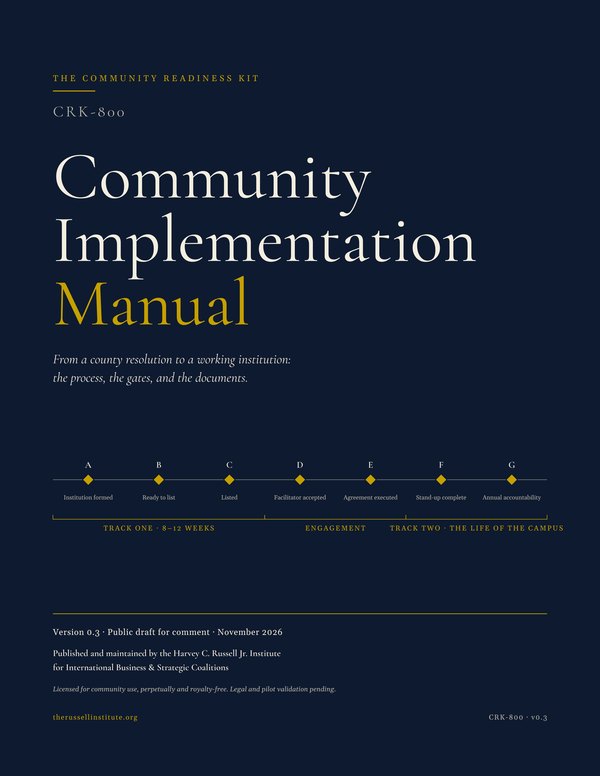
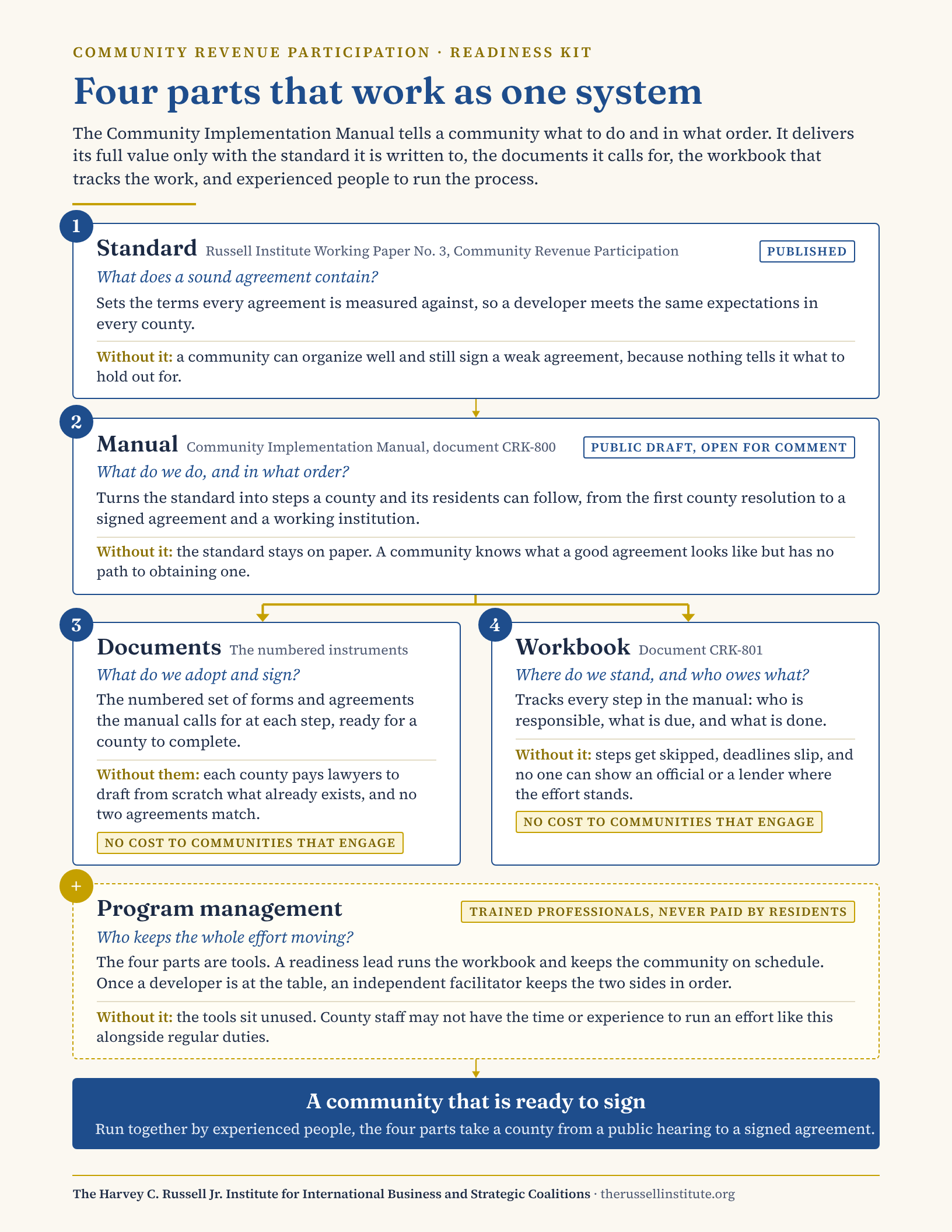
Diagram titled Four parts that work as one system. The standard sets the terms of a sound agreement. The manual turns the standard into steps. The documents and the workbook support each step. Program management by trained professionals keeps the effort moving. Together they lead to a community that is ready to sign.
The Community Implementation Manual is one of four parts. This page shows how the standard, the manual, the documents, and the workbook work together, and who runs the process. Open as a PDF.

In the press: Loren R. Douglass on data centers, ownership, and Frederick, The Baltimore Sun, September 21, 2026. The Governor signed Maryland's data center executive order two days later.  ·  The Root on the great wealth transfer and Black America, an interview with Loren R. Douglass, September 25, 2026.

Forthcoming Series

The Augmented Intelligence Series
How AI-human collaboration reshapes workforce strategy, institutional decision-making, and economic competitiveness. Drawing on the eleven-filing patent estate held by Vanguard Management Strategies, LLC, and the IntellOps™ Operating System framework.
The Inclusive Capitalism Series
Launched September 2026 with Working Paper No. 3, Community Revenue Participation, the Institute's proposal to Maryland's Data Center Accountability Task Force and a description of the process by which such an agreement is reached. Working Paper No. 4, Paid in Status, supplies the framework behind it: what ownership is made of and what the American majority was paid instead. Working Paper No. 5, The Host Community Exchange, proposes the marketplace that makes the agreement routine. CRK-800, the Community Implementation Manual, is the process a county runs to get there, published in November 2026 as a public draft for comment. How institutions can participate in the American system of wealth creation at the nexus of government, financial markets, and corporations — on terms that reflect the actual capabilities of their members and communities.

Join the Movement

Leadership

About the Founder

Loren R. Douglass

Loren R. Douglass

Founder & CEO

Full bio →

A career defined by bridging disciplines others keep separate—from engineering systems to structuring billion-dollar transactions, from international economic policy to institutional leadership, and now to building the technical and methodological foundations for human-AI collaboration.

51st Grand Sire Archon of Sigma Pi Phi Fraternity, the oldest African American Greek-letter organization. Member, Council on Foreign Relations. 33° Prince Hall Mason. Inventor on eleven pending U.S. patent applications in AI workflow orchestration and quality systems.

Johns Hopkins Engineering Wharton MBA SAIS International Economics & International Law Deloitte Consulting
The Power Doctrine Book Cover

The Power Doctrine: Building Black Wealth, Influence, and Institutions That Last

By Loren R. Douglass  •  Available Now

A comprehensive theory of institutional power introducing the Law of Institutional Asymmetry and the case for inclusive capitalism. Decoding the hidden architecture of American power.

Order Now at BookBaby

The Augmented Intelligence Series

The definitive framework for human-AI partnership. A three-volume progression from individual mastery to organizational transformation.

Volume I: Beyond AI — The Twelve Laws of Augmented Intelligence

Forthcoming 2026 — The foundational principles. How to think with AI. The 1:1 relationship between human and machine that transforms capability.

Volume II: The Augmented Thinker

Coming 2026 — The professional methodology. The Five Modes of Engagement. The ENSEMBLE Method. Systematic approaches to working across multiple AI models.

Volume III: The Augmented Organization

Coming 2027 — Scaling AI² across teams and institutions. Building Augmented Operating Systems. Organizational transformation for the AI era.

Seize the Future: The Boulé as a Force for Change

The foundational work on institutional transformation and the architecture of lasting power.